
Introduction
The US CMA and CMA India share three letters but lead to very different careers. The US CMA (Certified Management Accountant) is a global credential awarded by the Institute of Management Accountants (IMA). CMA India (Cost and Management Accountant) is a statutory qualification awarded by the Institute of Cost Accountants of India (ICMAI).
Both prove your skill in management accounting and financial management. The right choice depends on where you want to work, how much time you have, and whether you want a role backed by Indian law. This guide compares US CMA vs Indian CMA on 10 points so you can decide with confidence.
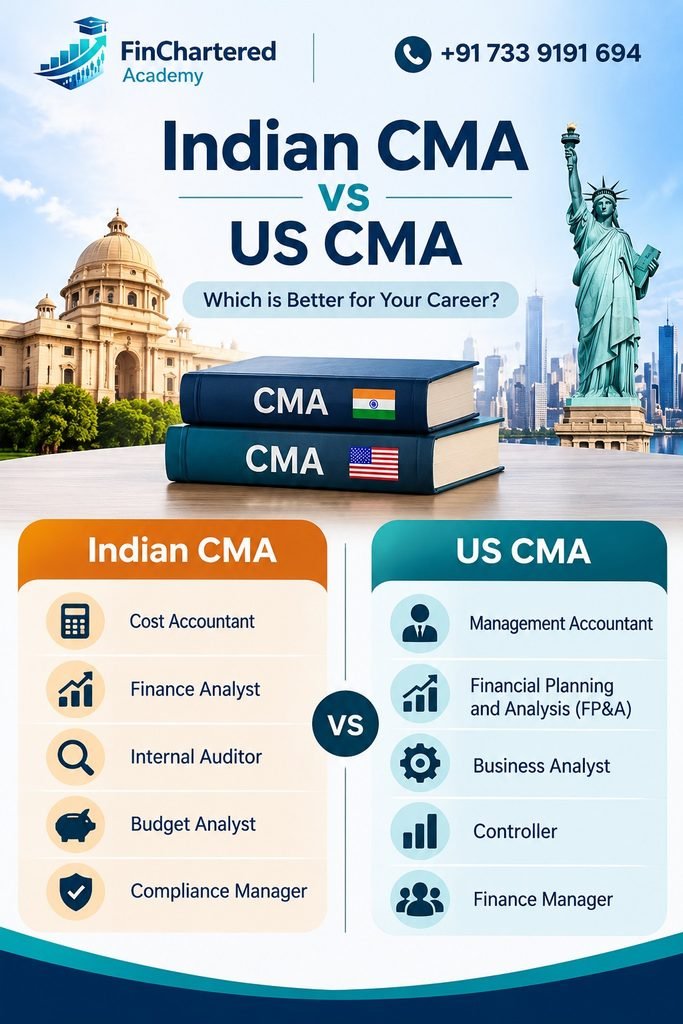
Quick answer: US CMA vs Indian CMA
The US CMA suits students who want a fast, globally recognised credential for MNC finance roles. It has 2 exam parts and can be finished in 6 to 12 months. CMA India suits students who want a statutory career in India, such as signing cost audit reports. It has 20 papers across 3 levels and takes about 3 years.
What is the US CMA course?
The US CMA course prepares you for the Certified Management Accountant exam run by the IMA, headquartered in the United States. The exam has two parts:
- Part 1: Financial Planning, Performance and Analytics
- Part 2: Strategic Financial Management
Each part is scored on a scale of 0 to 500, and you need 360 to pass. Exams are taken at Prometric centres, including centres in India. You can sit both parts while still studying for your degree, as long as you complete the degree and work experience within 7 years of passing.
What is CMA India?
CMA India is the Cost and Management Accountant qualification of ICMAI, a statutory body set up under the Cost and Works Accountants Act, 1959. The course runs in three levels: Foundation, Intermediate and Final. Under the 2022 syllabus, these levels have 4, 8 and 8 papers, for 20 papers in total.
CMA India also includes skills training and 15 months of compulsory practical training. Qualified members can practise as Cost Accountants and carry out statutory cost audits in India.
US CMA vs Indian CMA: comparison table
Point | US CMA | CMA India |
|---|---|---|
Governing body | Institute of Management Accountants (IMA), USA | Institute of Cost Accountants of India (ICMAI) |
Full designation | Certified Management Accountant | Cost and Management Accountant |
Eligibility to start | Can start during graduation; degree and 2 years of experience needed for certification | Class 12 pass for Foundation; graduates can enter at Intermediate |
Recognition | International | Indian, with statutory backing under Indian law |
Focus | Financial planning, performance, analytics and strategic financial management | Cost accounting, cost audit, taxation and Indian laws |
Exams | 2 parts | 20 papers across 3 levels |
Pass criteria | Scaled score of 360 out of 500 per part | 40% in each paper and 50% aggregate |
Practical training | Not required (work experience counts instead) | 15 months compulsory |
Duration | 6 to 12 months | About 3 years |
Accounting standards | US GAAP and IFRS | Ind AS and Indian regulations |

10 differences between US CMA and Indian CMA
1. Regulatory body
The US CMA is awarded by the Institute of Management Accountants (IMA), a global professional body based in the USA. CMA India is awarded by the Institute of Cost Accountants of India (ICMAI), a statutory body created by an Act of Parliament.
2. Eligibility
For the US CMA, you need a bachelor’s degree in any discipline and 2 continuous years of experience in management accounting or financial management. These are certification requirements, not exam requirements. B.Com and BBA students can join IMA, sit both exams during college, and complete the degree and experience within 7 years of passing.
For CMA India, students start at Foundation after Class 12. Graduates and some other qualification holders can enter directly at Intermediate.
3. Recognition
The US CMA is recognised internationally and is valued by multinational companies in India, the Middle East, the US and beyond. CMA India is an Indian qualification with legal backing from the Government of India. Only a practising Cost Accountant can conduct a statutory cost audit under the Companies Act, 2013.
4. Focus
The US CMA focuses on financial planning, budgeting, performance management, analytics, corporate finance and decision analysis. CMA India focuses on cost accounting, cost control, cost audit, taxation and Indian business laws.
5. Exams
The US CMA has only 2 exam parts. Each part has multiple-choice questions plus written or case-based questions. CMA India has 20 papers across Foundation (4), Intermediate (8) and Final (8).
6. Designation
US CMA holders use the title Certified Management Accountant. CMA India members use the title Cost and Management Accountant, and can be Associate (ACMA) or Fellow (FCMA) members of ICMAI.
7. Pass criteria
For the US CMA, you need a scaled score of at least 360 out of 500 in each part. For CMA India, you need at least 40% in each paper and 50% in aggregate in each group, at one sitting.
8. Practical training (articleship)
The US CMA has no articleship. Instead, you show 2 years of relevant work experience, which can be completed before or after the exams. CMA India requires 15 months of compulsory practical training, which can begin once you register for Intermediate.
9. Duration
Most students complete the US CMA in 6 to 12 months. CMA India usually takes about 3 years from Foundation, longer if you need extra attempts.
10. Accounting standards
The US CMA is based on US GAAP and IFRS, which makes it useful for global companies and shared service centres. CMA India is built around Indian Accounting Standards (Ind AS), Indian taxation and Indian regulations.
Which is better in India: US CMA or Indian CMA?
Neither is better for everyone. The right choice depends on the career you want.
- Choose the US CMA if you want an MNC, Big 4 or global shared services role in FP&A, budgeting or business analysis. It also suits you if you want to finish quickly alongside a B.Com or a job, or keep the option of working abroad.
- Choose CMA India if you want a statutory career in India, such as cost audit, practice as a Cost Accountant, or roles in PSUs and government organisations. It also suits you if you want deep knowledge of Indian taxation and laws.
- Consider both if you want strong domestic credentials plus global mobility. A CMA India background gives a good base for the US CMA, though IMA grants no exam exemption for it.
Conclusion
Both the US CMA and CMA India build strong careers in management accounting and finance. CMA India is tailored to Indian financial regulations and gives you statutory rights, and its members are sought after in both the private and public sectors. The US CMA focuses on global financial standards and strategy, which is why multinational companies in India actively hire US CMA professionals for finance and FP&A roles.
If you are comparing US CMA vs Indian CMA, start with your career goal: global corporate finance or a statutory role in India.
Looking for US CMA coaching in Chennai? FinChartered Academy, a CMA institute in Chennai, trains students for the US CMA with expert faculty and exam-focused guidance. Talk to our counsellors about the US CMA course and find the right path for you.

